


AI Agents Are Changing Smart Contract Security (And Most Auditors Don’t See It Coming)
TL;DR: AI agents are now auditing smart contracts, finding vulnerabilities, and deploying fixes autonomously. Most blockchain security teams haven’t noticed this shift yet. Here’s what’s actually changing and why traditional auditors are about to become obsolete if they don’t adapt.
Six months ago, an AI agent ran a continuous security audit on a Uniswap fork. It found a precision loss vulnerability in the fee calculation, generated a fix, tested the patch with fuzzing, and flagged it for human review.
No human in the loop. End-to-end security discovery, analysis, and remediation.
This isn’t science fiction. This is happening now. And most auditors don’t see it coming.
After 27 years in cybersecurity and hundreds of blockchain audits, I can tell you: AI agents are about to reshape the entire security industry. Not by replacing auditors — but by making traditional auditing look like manual code review looks today.
What Changed: Agents vs. Tools
There’s a fundamental difference between tools and agents:
Tools: You tell them what to do. “Run Slither.” “Fuzz with 50K iterations.” “Check for reentrancy.”
Agents: They decide what to do based on goals. “Audit this smart contract for security vulnerabilities. Fix any you find. Verify the fixes work.”
AI agents have goal-seeking behavior. They break problems into subtasks, use tools autonomously, and iterate until they achieve the objective.
What Agents Can Do Right Now (2026)
1. Continuous Vulnerability Scanning
An agent watches your deployed contract. When new code is pushed:
- Automatically runs static analysis (Slither, Aderyn)
- Generates and executes fuzz tests (Foundry)
- Compares against known vulnerability patterns
- Escalates findings with severity ratings and PoCs
No audit request needed. No 2-week turnaround. Continuous, autonomous monitoring.
2. Automated Patch Generation
When an agent finds a vulnerability:
- It generates candidate fixes (usually multiple)
- Tests each fix with the original fuzzing inputs
- Verifies fixes don’t introduce new vulnerabilities
- Suggests the best patch with explanation
Example: Reentrancy detected → Agent suggests Checks-Effects-Interactions pattern → Implements it → Tests with Echidna → Confirms safe.
3. Economic Attack Modeling
Agents now understand DeFi economics. They can:
- Model flash loan attack scenarios
- Simulate price oracle manipulation
- Identify liquidation cascades
- Calculate exact profit potential for each vector
The Bonq DAO $100M hack? An AI agent would have modeled that attack and flagged it before deployment.
4. Formal Verification Automation
Formal verification is extremely hard. Agents are making it practical by:
- Automatically generating invariants from code
- Creating proofs without manual specification
- Iterating on failed proofs to find violations
What took human experts weeks now takes agents hours.
5. Exploit PoC Generation and Testing
Agents write working exploits in Solidity/Foundry that prove vulnerability impact. They:
- Fork mainnet at specific blocks
- Replay exact attack conditions
- Calculate dollar amounts stolen
- Generate reproducible test cases
When I audit protocols, this is one of the most time-consuming parts. Agents do it in minutes.
Where Agents Still Fail (For Now)
Business Logic
Agents understand code. They don’t understand intention. If the code does exactly what the developer intended — but the intention is wrong — agents miss it.
Example: “Our protocol sends 1% of fees to governance, but the implementation actually sends 2%.” That’s not a code bug. That’s a business logic issue. Agents won’t catch it unless told explicitly what “correct” means.
Unstated Assumptions
Code is full of implicit assumptions:
- “We assume the admin isn’t malicious”
- “We assume the oracle won’t be manipulated”
- “We assume normal market conditions”
Agents test what’s in the code. They don’t always question the assumptions underneath. A human auditor asks “What if the admin IS malicious?” Agents are getting better at this but aren’t there yet.
Context and Narrative
Why does this contract fork Compound? What was the team trying to achieve? What past hacks influenced their design?
Agents operate on code. Humans operate on context. Right now, humans still have the edge here.
How This Changes the Industry (By 2026-2027)
What Dies
- Checklist auditing: “Did you check for reentrancy? Check. Did you check for overflows? Check.” Agents do this automatically.
- Basic vulnerability scanning: Tools > humans for finding common patterns.
- Manual test writing: Agents generate more comprehensive tests than humans.
- Documentation of audit findings: Agents write better reports with PoCs automatically.
What Evolves
- Auditor role shifts to architect review: “Does the design make sense? Are the economic models sound? Did you consider this attack vector?”
- Focus moves to assumptions and context: Why did you make these choices? What are you betting on?
- Higher-level security strategy: “Given your threat model, is this the right architecture?”
What Accelerates
- Audit turnaround time: From 2-4 weeks to 2-4 days
- Continuous security monitoring: Real-time rather than point-in-time
- Cost reduction: Basic audits become commoditized, expensive only for novel protocols
- Patch velocity: Find vulnerability → generate fix → test → deploy in hours, not weeks
The Skills That Will Matter Most
If you’re an auditor worried about obsolescence, here’s what to develop:
1. Economic and Game Theory Expertise
Agents understand code. Few understand whether the economic model is sound. Learn DeFi math, liquidation mechanics, MEV dynamics, oracle design.
2. Architecture and Design Review
“Is this the right technical solution for the problem?” Agents can’t answer that. Humans with experience can.
3. Prompt Engineering for Agents
The ability to specify security requirements clearly so agents understand what to look for becomes a superpower. “Find vulnerabilities where an admin can unilaterally change fees” is different from “Find vulnerabilities” — and dramatically changes what an agent finds.
4. Red Team Thinking
Agents follow patterns. Creative attack vectors still require creative humans. Who thinks about cross-protocol interactions the agent won’t model? Who imagines scenarios the agent never trained on?
What I’m Doing Right Now
At Polygon Labs, we’re building agent-assisted audit workflows. Not replacing auditors — augmenting them. The workflow looks like:
- Protocol team submits code
- AI agent runs automated analysis (1-2 hours)
- Agent flags findings with severity and PoCs
- Human auditors focus on architecture, economics, creative attacks (2-3 days)
- Agent runs continuous monitoring post-deployment
This gets us from 4 weeks to 4 days. And the audit quality is higher because humans aren’t wasting time checking for basic reentrancy — we focus on the smart stuff.
The Uncomfortable Truth
If you’re a “security auditor” whose value is finding reentrancy bugs and integer overflows, your job is being automated away. Not tomorrow. But soon.
The auditors who’ll thrive are the ones who:
- Understand DeFi economics deeply
- Think about architectural trade-offs
- Know how to prompt and interpret AI agents
- Can identify risks agents will miss
After 27 years in security, I’ve watched this pattern repeat across every domain. Tools commoditize low-level work. The people who thrive are those who evolve upward toward higher-level problems.
Smart contract security is no different. The low-hanging fruit — checklist vulnerabilities — is being automated. The high-value work — understanding whether a protocol’s design is fundamentally sound under adversarial conditions — remains human.
What’s Next
By end of 2026, expect:
- Major protocols have continuous AI agent monitoring
- Basic audit turnaround drops from weeks to days
- Audit costs fall 50-70% for standard engagements
- Human auditors focus exclusively on architecture and economics
- Agents capable of generating formal verification proofs autonomously
This isn’t threat — it’s opportunity. The protocols that combine agent automation with expert human review will have better security than anything we’ve seen before.
The question isn’t whether AI agents will change smart contract security. They already are. The question is: do you have the expertise to ride the wave, or will you be swept away by it?
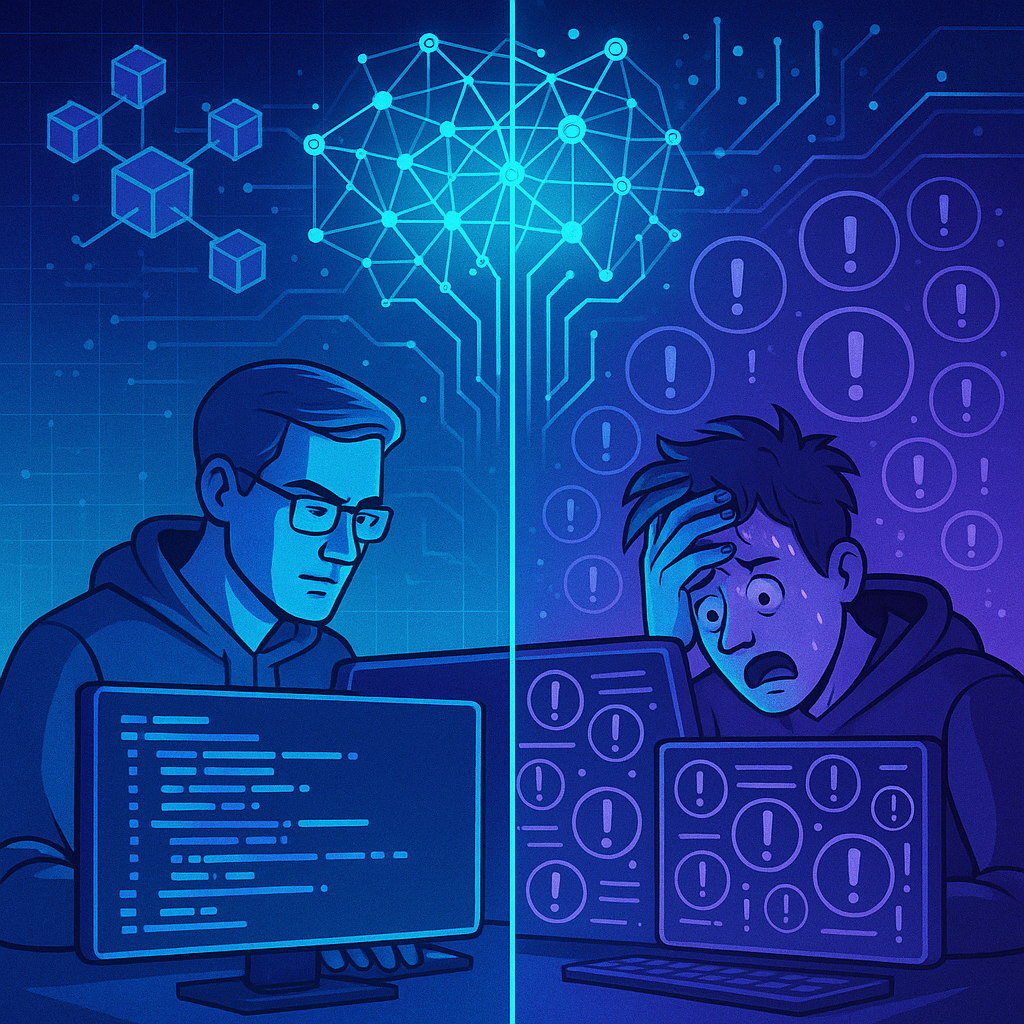
Because here’s the reality: AI amplifies what you are. XBOW hit #1 on HackerOne with 1,060 real vulnerabilities — built by experts. Meanwhile, curl shut down its bug bounty because AI-generated garbage reports overwhelmed them. Same technology. Opposite results.
The difference isn’t AI. Everyone has AI. The difference is the security foundation underneath it.
🔥 AI agents are rewriting the rules of smart contract security. The auditors who thrive will be the ones with deep expertise that AI multiplies. The Blockchain Security Master Program gives you that foundation — built on 27 years of real-world experience. Start with the free masterclass.
Disclaimer: This article was researched and written by members of BWH Academy, with AI-assisted research and drafting. While we strive for accuracy, details may slightly differ from exact real-world scenarios. All content is provided for educational and learning purposes only — not as professional security advice.



No Comments